From Overwhelmed to in Control: How Meditation Music Apps Gave Me My Calm Back
Life moves fast. Between work deadlines, family demands, and the never-ending ping of notifications, it’s easy to feel like you’re constantly running on empty. I used to lie awake at night, mind racing, wondering how I’d keep up. Then I found something simple but transformative—not a magic fix, but a daily anchor. Meditation music apps didn’t change my circumstances, but they changed how I showed up for them. Now, I breathe deeper, focus better, and feel more like *me*. And the best part? This calm isn’t reserved for retreats or quiet cabins in the woods—it fits right into my messy, real life.
The Breaking Point: When Noise Became Too Much
There was a Tuesday—just an ordinary one, really—when everything cracked. I was in the kitchen, one hand stirring soup, the other holding my phone, responding to a work email while my youngest asked for help with homework and my older daughter practiced her piano piece—off-key, loudly, and on repeat. The dog barked at the mail carrier, my phone buzzed with a calendar alert, and I suddenly froze. My chest tightened. My thoughts spiraled. I couldn’t focus on any one thing, yet everything demanded my attention. I remember leaning against the counter, soup spoon in midair, thinking: I can’t do this anymore. Not because the tasks were impossible, but because I had no space left inside myself to handle them.
That moment wasn’t unique. It had been building for months—years, maybe. I was doing everything “right”: showing up for work, keeping the house running, helping the kids with school, staying connected with friends. But I felt like a shell. I’d wake up already tired, drag through the day, and collapse at night, only to lie awake replaying every unfinished task and awkward conversation. I wasn’t depressed, exactly, but I was worn down—mentally, emotionally, physically. I’d lost the sense of joy in small things. The quiet moments, if they came, were filled with guilt instead of peace. I kept asking myself, “Why can’t I just feel calm?” It wasn’t until a friend gently said, “Maybe you’re not giving yourself a chance to,” that I realized I hadn’t truly paused in a long time. Not really. Not in a way that let my nervous system settle.
I didn’t need another productivity hack. I needed a reset. But I didn’t have time for hour-long yoga sessions or silent meditation retreats. I needed something that fit *my* life—messy, loud, unpredictable. Something simple. That’s when I started looking into meditation music apps. Not because I believed in them at first, but because they seemed small enough to try. No commitment, no pressure. Just sound. And honestly? I was desperate enough to try anything.
Discovering the Right Kind of Sound: More Than Just Background Noise
I’ll admit—I used to roll my eyes at meditation. It sounded like something for people who had time to sit cross-legged on mountain tops, sipping green tea and chanting. I didn’t have that kind of life. My version of stillness was collapsing on the couch after everyone was in bed. So when I first downloaded a meditation music app, I did it half-heartedly, expecting to delete it within a week. But what surprised me was how approachable it felt. I didn’t have to “meditate” in the traditional sense. I could just press play. No instructions, no expectations. Just music—soft piano, ambient tones, nature sounds like rain or ocean waves. It wasn’t about emptying my mind. It was about giving it a place to rest.
What made these apps different from other wellness tools was their flexibility. I could use them while folding laundry, sitting in my parked car before walking into the house, or lying in bed with my eyes closed. They didn’t require special clothes, a quiet room, or even silence. In fact, the background noise of life didn’t ruin the experience—it became part of it. The app didn’t ask me to escape my world. It helped me stay present within it. I started to notice how certain sounds made me feel. A slow cello melody brought tears to my eyes—soft, deep, comforting. A forest soundscape slowed my breathing without me even trying. And a 5-minute guided breathwork track helped me pause before reacting when my daughter spilled juice on her homework—again.
I began to understand that sound isn’t just background. It shapes our inner world. Think about it: a baby calms to a lullaby. We feel energized by an upbeat playlist. A familiar song can bring back a memory instantly. So why wouldn’t intentional sound help us feel more centered? These apps weren’t offering spiritual enlightenment—they were offering emotional regulation through something simple, accessible, and human: music. And the best part? I didn’t have to believe in anything special to benefit. I just had to press play.
From Chaos to Calm: The First Real Shift
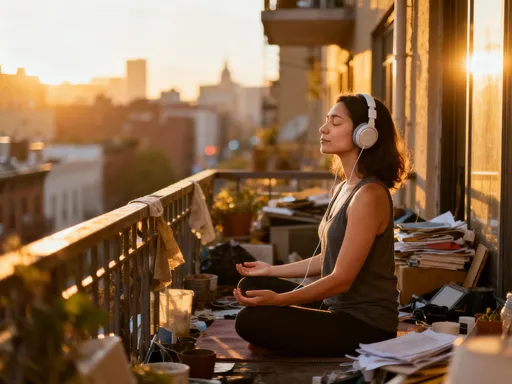
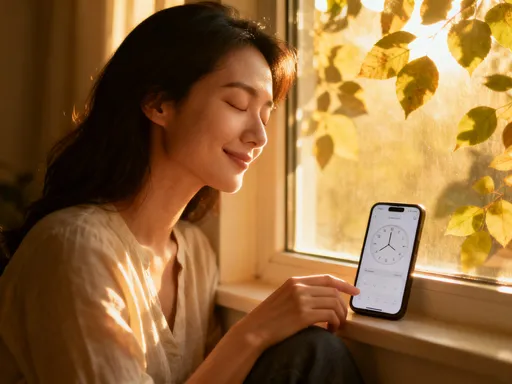
The first time I truly felt the shift, I was in the middle of a work crisis. A project deadline had moved up, and I was on a tense call with my team, trying to stay calm while my heart pounded. After hanging up, I felt shaky—angry at myself for not speaking up, worried about failing, overwhelmed by the workload. Instead of diving into the next task, I remembered the app on my phone. I closed my office door (okay, my bedroom—my “office” since the pandemic), put in my earbuds, and selected a 7-minute “Calm Focus” track. It started with a soft chime, then a slow, repeating piano line layered with gentle rain. A voice—calm, warm, unhurried—guided me to notice my breath, not to change it, just to feel it.
Within minutes, something shifted. My shoulders dropped. My breathing slowed. The knot in my chest loosened. I wasn’t fixing the problem yet, but I wasn’t drowning in it either. For the first time in hours, I felt like I could think clearly. When the track ended, I didn’t jump back into work. I sat for another minute, just feeling the quiet. Then I opened my laptop and made a simple to-do list. One step at a time. That moment didn’t solve my workload, but it changed my relationship to it. I wasn’t reacting. I was responding.
That experience became a turning point. I started using the app not just during big crises, but in small, everyday moments. When I couldn’t sleep, I played a “Deep Sleep” track with slow harp music and distant thunder. When the kids were arguing in the backseat, I turned on a “Peaceful Drive” playlist to keep my own stress from spiking. These weren’t dramatic interventions. They were tiny resets. But over time, they added up. I began to notice that I wasn’t as reactive. I could pause before snapping. I could choose how to show up, even when things were hard. And that, more than anything, made me feel like I was regaining control.
Building a Habit That Stuck: Small Moments, Big Impact
One of the reasons I’ve stuck with meditation music apps—unlike so many other self-care tools I’ve tried—is that they fit into my life instead of demanding I reshape my life around them. I used to think habits had to be big to matter. Wake up at 5 a.m. Journal for 20 minutes. Meditate for 30. But life with kids, work, and aging parents doesn’t always allow for perfect routines. What these apps taught me is that small, consistent moments matter more than long, ideal ones.
I started building micro-practices into my day. Five minutes while my coffee brews. Three minutes while waiting for the microwave. Ten minutes during my lunch break, sitting in the car with the windows down. The app’s gentle reminders helped—not in a nagging way, but like a kind friend saying, “Hey, you’ve got this. Take a breath.” I loved that I could save playlists for different needs: “Morning Clarity,” “Evening Wind Down,” “Focus Boost.” Some days, I didn’t even close my eyes. I just listened while folding laundry or wiping the counter. The music became a signal to my brain: this is a pause. This is for me.
The app also had a simple progress tracker—not to make me feel guilty if I missed a day, but to celebrate showing up. After two weeks of daily use, I got a little message: “You’ve created 70 minutes of calm this week. That’s 70 minutes you chose yourself.” It wasn’t about performance. It was about awareness. I began to see these moments not as luxuries, but as necessary maintenance—like brushing my teeth or charging my phone. And the more I did it, the more natural it felt. I didn’t have to “find” time. I could *create* it in the spaces I already had.
Beyond Stress Relief: Unexpected Gains in Focus and Creativity
I downloaded the app to feel less stressed. But what I didn’t expect was how much clearer my thinking would become. After a few weeks of regular use, I noticed I could focus longer on tasks without getting distracted. I remembered things more easily. I made decisions with more confidence. At work, I started approaching problems differently—not with panic, but with curiosity. One afternoon, I was stuck on a presentation, staring at a blank slide. Instead of pushing through, I played a 10-minute “Creative Flow” track. It had soft strings and a subtle rhythm, like a heartbeat. Halfway through, an idea popped into my head—simple, but effective. I didn’t force it. It just came.
That happened more often. I’d be washing dishes, and a solution to a family scheduling conflict would appear. I’d be walking the dog, and a new idea for a personal project would unfold. It wasn’t magic. It was what happens when your mind isn’t constantly overloaded. When the noise quiets down, space opens up. Ideas have room to breathe. Emotions settle enough to hear your own intuition. I started to see my mind not as a to-do list, but as a garden. The music was like watering it—gentle, consistent care that helped good things grow.
Even my creativity came back. I’d forgotten how much I enjoyed writing, but one night, after a calming music session, I opened an old journal and started scribbling. Not because I had to, but because I wanted to. I wasn’t writing for anyone. I was just expressing. That small act reminded me of who I was beyond my roles—as a worker, a mom, a partner. I was someone with thoughts, dreams, and a quiet inner voice that had been drowned out by noise. Reconnecting with that part of myself felt like coming home.
Sharing the Calm: Strengthening Relationships Through Shared Practice
One of the most beautiful surprises was how these apps helped my relationships. I didn’t expect to share them with my family, but it happened naturally. My daughter, who struggles with anxiety before tests, asked what I was listening to one night. I showed her the app and let her pick a “Calm Mind” track. We listened together before her big math exam. She said it helped her stop worrying and just focus. My husband, usually skeptical of anything “wellness,” admitted he felt less tense after using a “Deep Relaxation” session during a stressful week at work. Even my mom, who lives across the country, started using one when she couldn’t sleep.
We began creating small shared rituals. Before bedtime, my younger daughter and I would listen to a 5-minute “Goodnight Peace” track with soft lullaby melodies and crickets chirping. It became our quiet time—no screens, no questions, just stillness. On long car rides, we’d play a “Family Harmony” playlist to ease the tension of being cooped up. After a disagreement, instead of letting resentment build, I’d say, “Let’s just listen to something for five minutes,” and we’d reset together. These moments didn’t fix every problem, but they created space for connection. We weren’t just sharing time. We were sharing calm.
What I love most is that these apps gave us a common language for emotions. Instead of saying, “You’re being too loud,” I could say, “I think we all need a reset. Want to listen to something?” It removed blame. It invited cooperation. And it taught my kids that it’s okay to pause, to breathe, to care for your mind. That’s a lesson I wish I’d learned earlier.
A New Kind of Control: Not About Perfection, But Presence
Looking back, I realize these meditation music apps didn’t give me control over my schedule, my workload, or the chaos of daily life. They gave me something better: control over how I meet it. I’m not perfect. Some days, I skip my session. Some days, I still get overwhelmed. But now I have a tool—a simple, accessible, gentle way to come back to myself. I don’t use it to escape life. I use it to show up for it—more fully, more calmly, more kindly.
The biggest shift has been in how I define control. It’s not about managing every detail or being “on” all the time. True control is the ability to pause, breathe, and choose how to respond—even when everything feels out of sync. It’s about presence, not perfection. And that kind of control doesn’t come from pushing harder. It comes from slowing down.
If you’re feeling stretched thin, if your mind never seems to quiet, if you’re wondering how to keep going—know this: you don’t need more time, more energy, or a perfect life. You just need a few minutes, a pair of earbuds, and the willingness to listen. Try a meditation music app not as another task to check off, but as a gift to yourself. Press play. Breathe. Let the sound carry you, even for just five minutes. You might be surprised how much calmer, clearer, and more like yourself you can feel—right in the middle of it all.